
Oakland Park Directory Collections
No verified, continuous run bears only the Oakland Park name. The sound approach is broader. Search Oakland Park city directory evidence in Fort Lauderdale telephone books, State Library holdings, Broward periodicals, and the city archive. Each collection has a different reach. The table distinguishes exact date ranges from collections whose item dates vary, so a broad regional run is not mistaken for proof that every Oakland Park household appears.
| Collection | Years | Where Held | Access |
|---|---|---|---|
| Fort Lauderdale telephone books | Verified runs from 1936 through 1963; white pages 1971/72 through 1974/75 | Library of Congress | Catalog and directory guide |
| Florida city directories | Early 1900s to present statewide scope | State Library of Florida | Catalog, reference help, and on-site use |
| Local phone books and newspapers | Older telephone books; complete local newspaper run | Broward Main Library periodicals | Microform, staff retrieval, and remote article requests |
| Oakland Park historical archive | Farming-town beginnings through modern city; dates vary | Ethel M. Gordon Oakland Park Library | Digital browse, visit, or copy request |
| Broward Digital Archives | Collection-specific | Broward County Library | Free online search and browse |
The Library of Congress guide verifies separate Fort Lauderdale runs: June 1936 through August 1940, January 1941 through February 1947, August 1947 through August 1951, September 1952 through October 1954, and shorter runs through March 1963. Those dates do not guarantee an Oakland Park entry in every issue. The State Library likewise confirms a century-scale Florida collection, but researchers should ask which volume includes Oakland Park or its vicinity before citing it.
Oakland Park Directory Name Traps
Catalog labels changed with the region. A smaller community could be filed under Fort Lauderdale, “Fort Lauderdale and vicinity,” Broward County, or a telephone exchange. Oakland Park also passed through older identities. The settlement was known as Colohatchee in the 1910s, the larger Town of Floranada incorporated in 1925, and Oakland Park incorporated in 1929 after the boom failed.
This geography is not just local color. Early city limits covered a far smaller area, and records from the former Floranada expanse may carry Fort Lauderdale or county labels. Search each place term, then compare the street and person. The story is a real historical-index trap: a name can vanish from one catalog heading while remaining in another source for the same area.
Key point. Treat Colohatchee, Floranada, Oakland Park, Fort Lauderdale, and Broward County as alternate catalog paths, not interchangeable proof.
Oakland Park Directories Statewide
The State Library of Florida city-directory collection spans the early 1900s to the present and is arranged by city and then year. Its public page does not identify a complete Oakland Park run. Search the catalog, try Fort Lauderdale and vicinity titles, and call the reference desk at 850-245-6682 to confirm a volume before planning a visit.
A reference confirmation should include the title, year, publisher if shown, and whether the book contains an alphabetical section, street section, or both. That small check prevents a wasted trip and gives a reliable citation. The statewide shelf is strongest as a bridge between known dates, not as a promise of yearly coverage.
The manifest captured the State Library directory gateway used for that first catalog check.
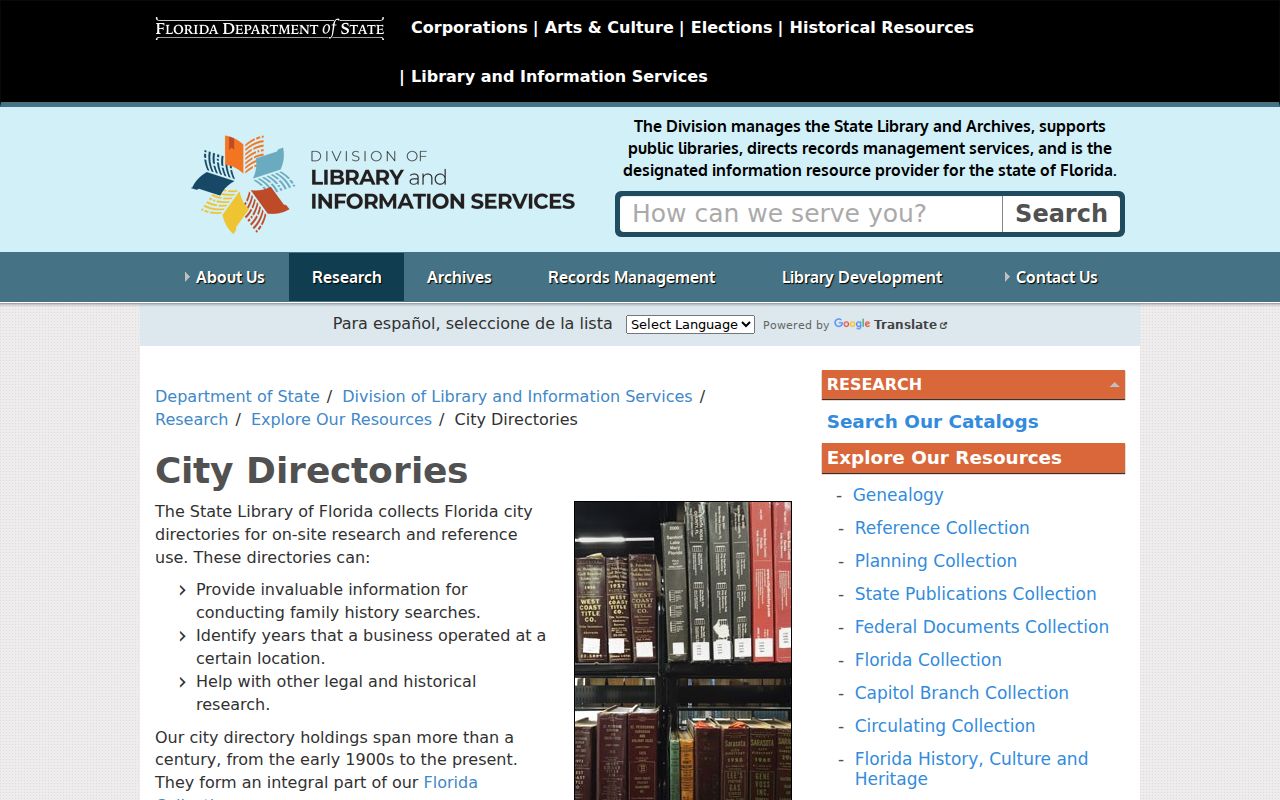
The page confirms the collection's statewide date span and arrangement, while the catalog or reference desk supplies the city-specific volume answer.
Note: Record the exact catalog title because a regional volume may contain Oakland Park even when the city is absent from its cover.
Oakland Park Historical Archive
The Ethel M. Gordon Oakland Park Library holds photographs and documents gathered by the Oakland Park Historical Society and the city. The official history and archive gateway links a digital collection, local histories, and copy help. Visitors may inspect materials or request copies at 954-630-4510. Item dates and completeness vary, so a digital search should be followed by a staff question when a family, street, school, church, or business is missing.
Two city histories add names and context. Ruth Brenner's Oakland Park's History reaches from early settlement into the mid-century. Paul S. George's Twentieth Century Journey cites archival files and newspapers. These narratives provide leads, not substitute resident rolls. Confirm a named person with a directory, census, deed, or newspaper record.
The archive has a preservation history of its own. City planning material reports completed digitization phases with regional partners, while a 2019 county profile described thousands of artifacts under inventory. “Digitized” does not mean complete. Physical inspection and copy requests remain valid access channels.
The only successful Oakland Park city directory image in the manifest comes from the Broward County Digital Archives.
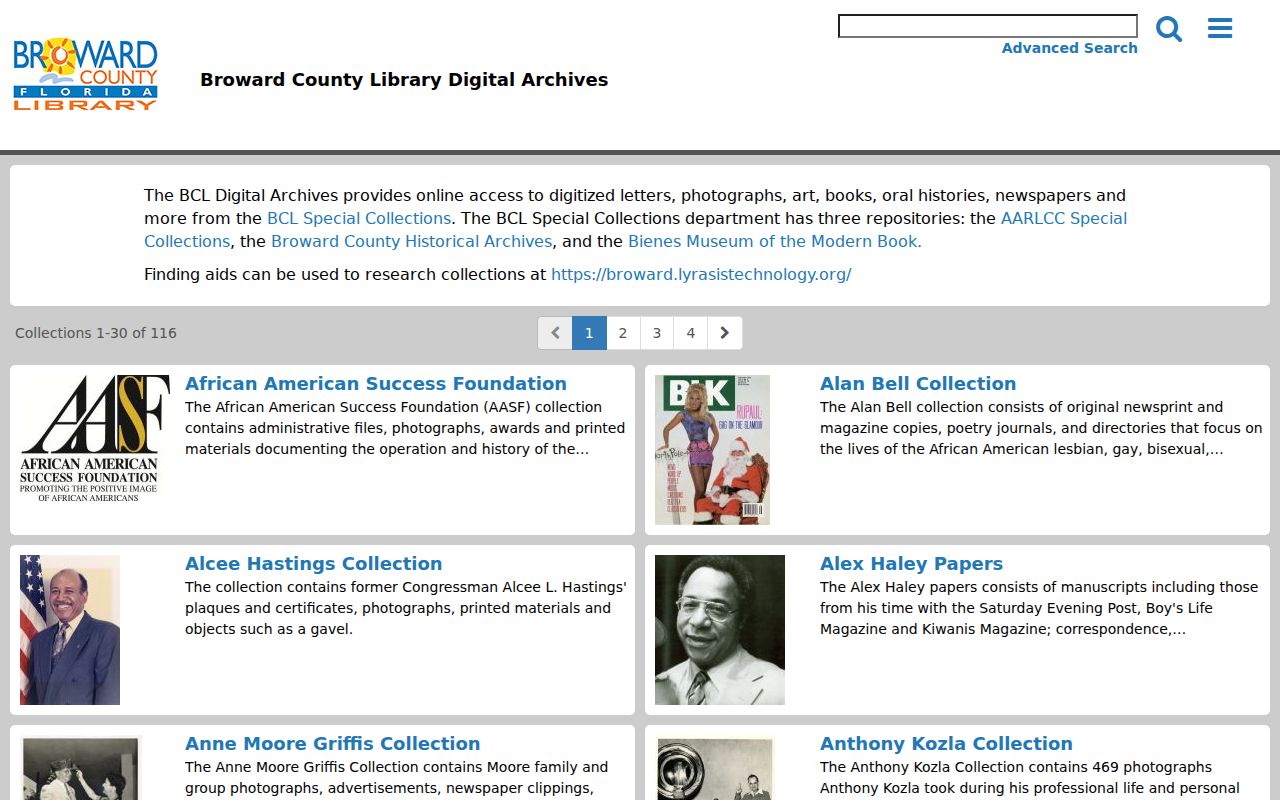
The archive screen illustrates the countywide collection route, where names may sit inside family, organization, photograph, or subject collections rather than a stand-alone directory volume.
Reading Oakland Park Directory Entries
No open official scan exposed a verified Oakland Park entry during research, so this is a reading inventory, not a made-up sample. An alphabetical personal line may give a surname, given name or initial, spouse, occupation or employer, and residence address. A business entry may add a classification, proprietor, manager, phone, and business address. Always photograph or note the front-matter key before interpreting short marks.
| Name line | Surname, given name or initial, and sometimes a spouse in parentheses |
|---|---|
| Work detail | Occupation or employer when the publisher collected it |
| Residence | House number and street as printed in that edition |
| Business line | Firm, classification, named proprietor or manager, phone, and address |
| Status mark | Publisher-specific abbreviations, which must be checked against that volume's key |
- Criss-cross directory
- A street-and-house-number section that turns an address into a listed occupant or subscriber.
- Householder index
- A list organized around a household name or address rather than a broad subject.
- Abbreviation key
- The volume's own legend for short forms. Meanings can change by publisher and year.
Oakland Park Address Changes
Historical addresses need to be preserved as written. City history identifies Ocean Boulevard as today's Oakland Park Boulevard and also notes an older “Oakland Boulevard” at NE 34th Court. Silently replacing either name can join the wrong property to the wrong person. Record the old spelling, direction, house number, subdivision, and nearby landmark before testing a modern form.
Rail and road patterns also shaped early listings. The Florida East Coast Railway and Dixie Highway organized commerce, and the Methodist church served as a social hub. A resident absent from a residential column may appear in a packing-plant notice, church activity, school group, farm report, or business line. This is especially useful for the sparse years before postwar growth made telephone and criss-cross sources denser.
Oakland Park Directory Gap Fillers
Broward Main Library keeps older telephone directories and a complete run of local South Florida newspapers in its periodicals section. Staff retrieve microform, teach readers how to use it, and accept out-of-area obituary or article requests by email, phone, or mail. The periodicals service is therefore the main fallback when a directory year is absent or available only inside the library.
Oakland Park Library links the Sun-Sentinel from 1986 onward, plus Miami Herald and El Nuevo Herald products. Search a full name with an address, spouse, school, club, church, or business. An obituary may resolve a disappearance; a wedding notice may explain a surname change; and an opening announcement can connect a proprietor to an address without proving that the person lived there.
Note: Broward periodicals staff can retrieve a targeted article remotely, but a narrow name, date range, and event will make the request far more useful.
Trace Oakland Park Directory Households
City directories are snapshots, not full household schedules. Follow a person on both sides of a target year, then pair those listings with the nearest released census. As of 2026, the 1950 federal population schedule is the latest public census under the 72-year rule. It can add household relationships, ages, birthplaces, and occupations that a directory often leaves out.
- Keep every spelling and historical form of the address.
- Check each adult surname in the alphabetical list, then inspect the street section if one exists.
- Move one available volume earlier and later. Note every spouse, work detail, phone, and address exactly.
- Compare the nearest released census through National Archives census resources.
- Use newspapers, obituaries, deeds, and property rolls to test the result.
A first appearance gives a move-in bracket, not an exact date. A disappearance may mean a move, death, unlisted phone, missed canvass, boundary shift, or publisher change. Check the next volume and a newspaper date range before deciding. Ownership must also be proved separately. A listed occupant may have rented, while the tax-roll owner may have received mail elsewhere.
For the modern address-keyed side of the research, the Oakland Park street directory explains the parcel and official-record chain. Keeping the modern roll separate from the historical shelf avoids turning an owner's name into an unsupported household claim.