
Oakland Park Lookup Evidence
A sound resident lookup separates what each public record proves. The Broward County Property Appraiser identifies an assessed owner and shows both the parcel's physical, or situs, address and the owner's mailing address. That does not prove who lives there. The Broward Clerk party search links a name to a filed court case, while a voter record reflects registration data subject to exemptions. Vital records confirm events under their own access rules. Business and license systems can connect a person to a public role or credential.
Start with the source closest to the fact at issue. Then seek a second source with a matching middle name, address, date, spouse or co-owner, folio, case number, or license number. A name alone is weak proof in Oakland Park and across Broward County.
| Record | What It Confirms | Where | Access |
|---|---|---|---|
| Property roll | Owner, situs, mailing address, folio, sale references | Broward Property Search | Free, no login |
| Court docket | Case, parties, filing date, events and status | Broward Clerk Case Search | Free index; document limits vary |
| Voter record | Registration status and releasable registration facts | Supervisor of Elections | Identity-gated self-lookup or records request |
| Vital record | Birth, death, marriage, or dissolution event | Florida Vital Statistics | Eligibility and copy rules differ |
| Business or license | Public filing role, credential, status, or business address | Sunbiz and DBPR | Free public searches |
Refine Oakland Park Court Lookups
Oakland Park cases appear in Broward County Court and Florida's Seventeenth Judicial Circuit. The party search requires a court-type group and a last name or business name. First and middle names are optional. Case type and filing-date fields narrow broad results. The portal caps a public result set at 200, so a common surname should be paired with a court group, date range, and full given name.
Results can show the case style, number, court type, filing date, status, judge, parties and roles, attorneys, docket events, and public document links. A docket is the dated list of activity in a case. It is a lead, not identity proof. Online documents are redacted, and some images are absent or restricted. The web display is not the official court record.
View the official Broward party and case lookup before choosing the court type and name fields.
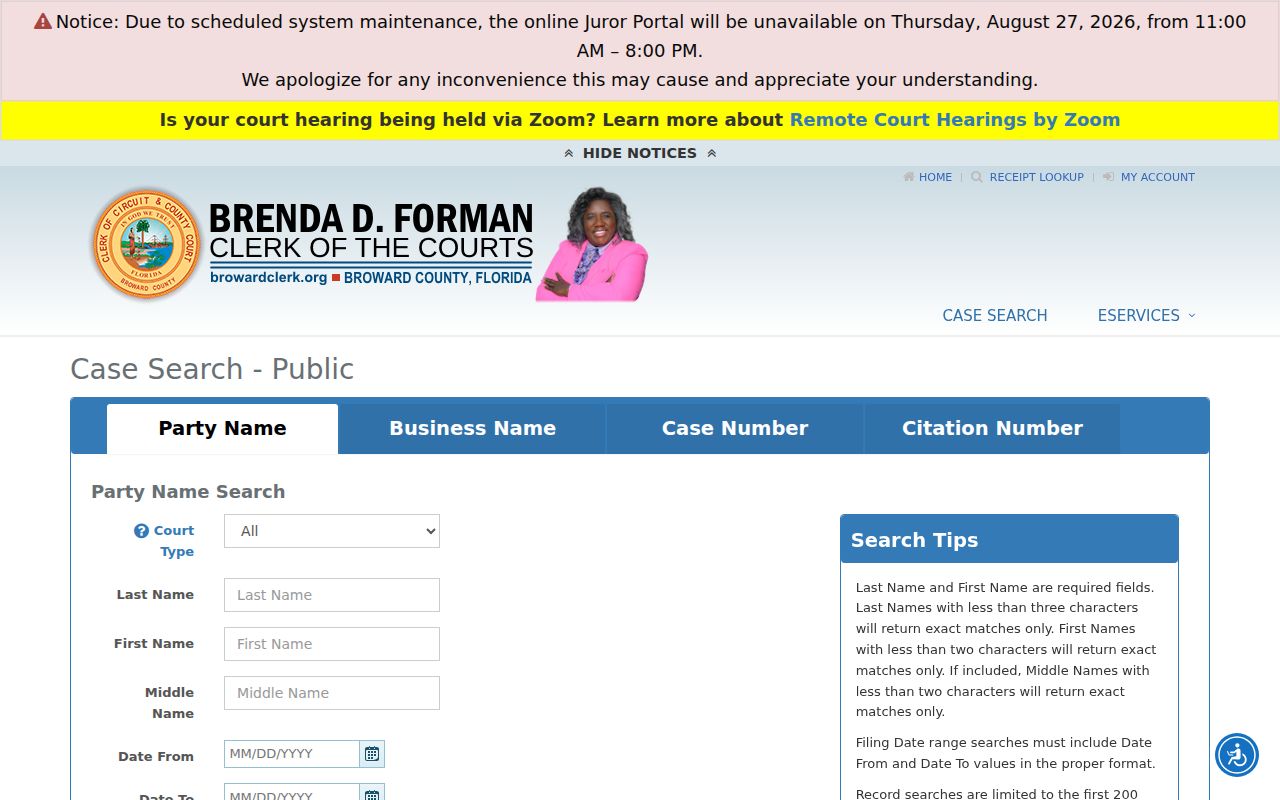
The portal screen shows why court group, date range, and full name are needed to control a broad resident lookup.
| Field | Use | Requirement |
|---|---|---|
| Court Type | Civil, family, probate, or criminal/traffic group | Required in party mode |
| Last Name / Business | Main party-name term | Required |
| First / Middle Name | Reduce same-name matches | Optional |
| Case Type | Narrow within court group | Optional |
| Date From / To | Limit filing period | Optional |
The Clerk's records-request channel is the fallback for an incomplete online file. Give the case number, docket event, and named documents. Division staff at the Broward County Judicial Complex can also explain access. Sealed, adoption, juvenile, and some family or probate material stays restricted.
Verify Oakland Park Resident Records
One careful sequence prevents most mistaken matches. Keep the role attached to each name. A trustee, lienor, registered agent, lawyer, permit applicant, or personal representative is not automatically an owner or resident. Dates matter too. A deed fixes a past event, the assessment roll changes on its cycle, and voter extract data can lag.
- Search the full name in BCPA with Oakland Park selected as the city. Record the folio, situs, mailing address, and exact owner spelling.
- Follow the parcel's deed reference into Broward Official Records. Match the legal description and note whether the person is grantor or grantee.
- Run the Broward court party search with middle name, court type, and a useful date range. Compare identifiers, not the surname alone.
- Use a vital, voter, business, or license record only for the distinct fact it can confirm. Ask the custodian for an official copy when proof is needed.
- Docket
- The chronological list of filings and actions in a court case.
- Index versus image
- An index points to a record; an image shows the filed document itself.
- Certified copy
- A copy authenticated by the government office that keeps the record.
- Folio
- Broward's parcel identifier, useful for matching property and deed evidence.
Oakland Park Voter Confirmation
The Broward Supervisor of Elections status tool asks for first name, last name, and date of birth. It is designed for personal verification, not open browsing. A successful search may show status, party, precinct and districts, polling information, vote-by-mail status, and participation history. Participation means the voter was credited in an election. The secret ballot never reveals a candidate or issue choice.
A broader resident lookup must use an official extract or public-record request. Releasable fields can include name, residence and mailing address, party, status, registration date, precinct, districts, and voting history. Florida law protects Social Security and driver-license numbers, registration-source data, copied signatures, preregistrants' information, and protected addresses. The official data channel may omit people for lawful reasons, so absence is not proof that a person moved.
Oakland Park Vital Record Checks
Florida vital records answer event questions, not current-address questions. Marriage and dissolution certificates are public. The state Bureau covers those events from June 6, 1927, while the Broward Clerk holds the recorded marriage license and court divorce file. The state certificate is a short verification; the county file may contain more, subject to court restrictions.
Recent births are confidential for 125 years under section 382.025, Florida Statutes. Death certificates without cause are public, but cause-of-death data remains confidential for 50 years and has an eligibility test. A recent birth record or cause-of-death request needs proof of identity and relationship or authority. That contrast matters when trying to reconnect with family: a public index result does not waive the certificate rules.
The state forms hub lists the current applications. For records before the state marriage and dissolution coverage date, contact the county where the license or decree was filed.
Review Florida's official birth-certificate access page for current eligibility and application routes.
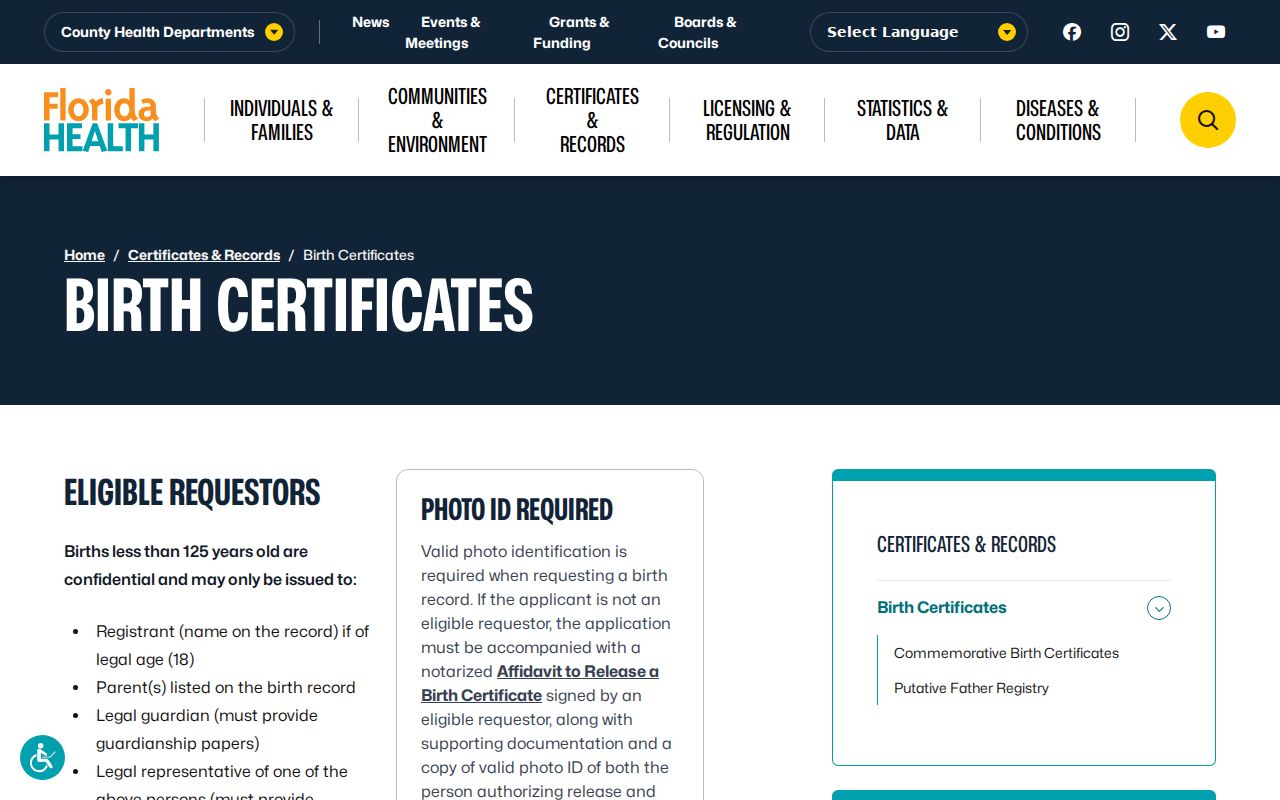
The state page keeps a restricted certificate request separate from public marriage and dissolution checks.
Confirm Oakland Park Public Roles
A person may surface through a business or professional role even when property results are thin. Sunbiz supports officer and registered-agent name searches, along with entity, street, and ZIP modes. A detail may show filing status, principal and mailing addresses, officer or manager names, annual reports, and free document images. A registered office is a business contact, not proof of a home.
DBPR can search by individual name, organization, city or county, license number, category, and license type. Historic-license results may retain an old address. Match the license number and status before tying the entry to an Oakland Park person. The professional name-search screen shows the controls used for that check.
View the official DBPR name-search form before entering a name.
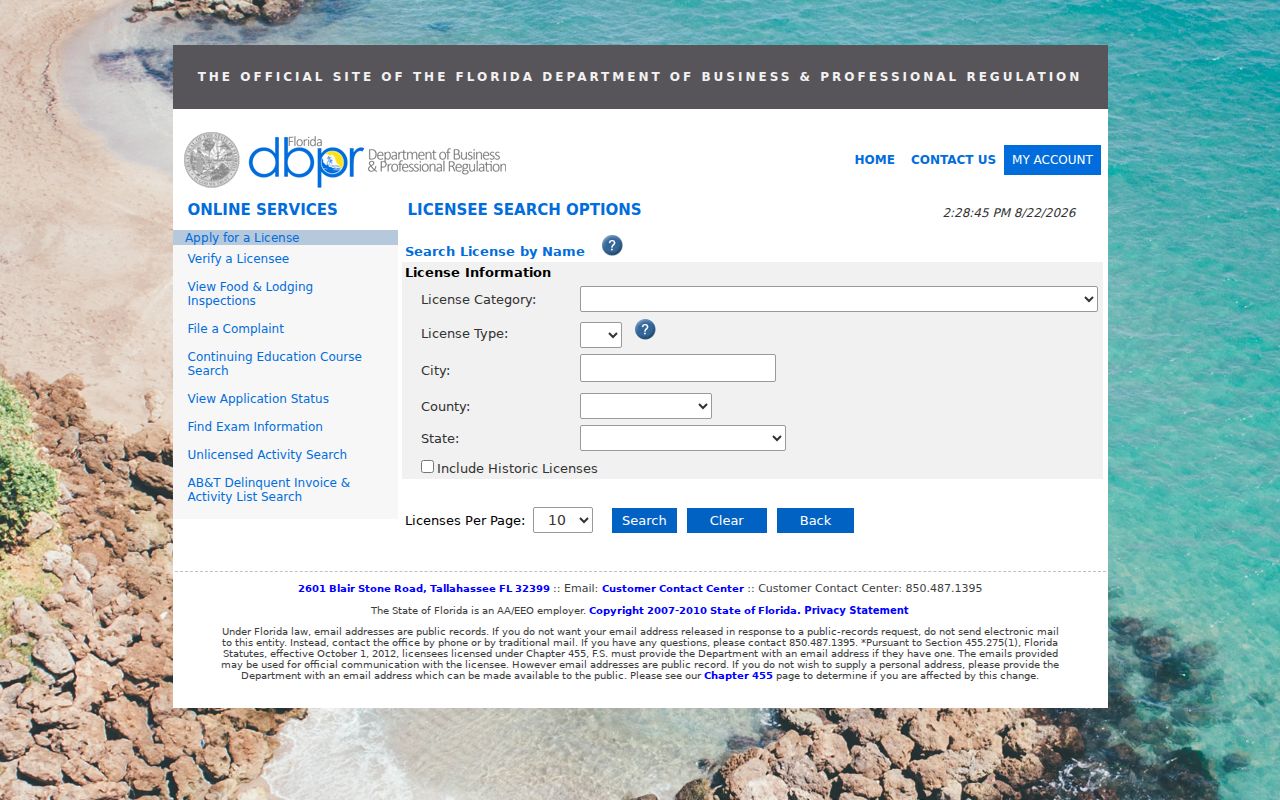
The form's spelling and historic-license choices help distinguish a current credential from an older public affiliation.
Oakland Park Lookup Fallbacks
When a portal stops short, contact the custodian that made the record. Florida Public Records Law, article I, section 24 of the state constitution and chapter 119, does not require a special form or stated purpose for an ordinary public-record request. A focused request gets a more useful response. Give a case number, parcel folio, document type, date range, or exact name rather than asking for every record about a person.
Older deeds require Broward Search and Copy Services because the online index begins in 1978 and online images begin August 24, 1998. Court files use the Clerk, not the recording office. Corrections belong with the keeper too: BCPA handles roll issues, the elections office handles registration, and a recorded instrument cannot simply be edited because a later search result is inconvenient.
Reconnecting Through Oakland Park Records
Probate files and public obituaries can help identify an heir or reconnect relatives after a death. The Ethel M. Gordon Oakland Park Library archive holds local images and documents, while Broward Main Library periodicals staff accept remote obituary and article requests. Yearbooks, school groups, and community archives may help with a former classmate. These are starting points, and personal recollections still need corroboration.
Florida's free unclaimed-property channel can also return an earlier name or address clue while helping the owner claim property. Keep the purpose narrow and respectful. Do not infer kinship from a shared address or expose the location of a protected person.
Oakland Park Lookup Legal Limits
Florida's Safe Address program gives qualifying victims a substitute address and mail forwarding. Other exemptions protect certain occupations and statuses. Sealed or expunged court matters, juvenile and adoption files, confidential vital data, and restricted motor-vehicle information are not gaps to work around. Commercial opt-outs do not erase the official source record, and the Florida Digital Bill of Rights is not a universal deletion law.
A resident lookup should also preserve uncertainty. Ownership does not equal occupancy. A public record can be old, wrong, or tied to a different person with the same name. Verify with the custodian before relying on it.
For a focused personal-safety question, FDLE provides the official offender search with name and geographic modes.
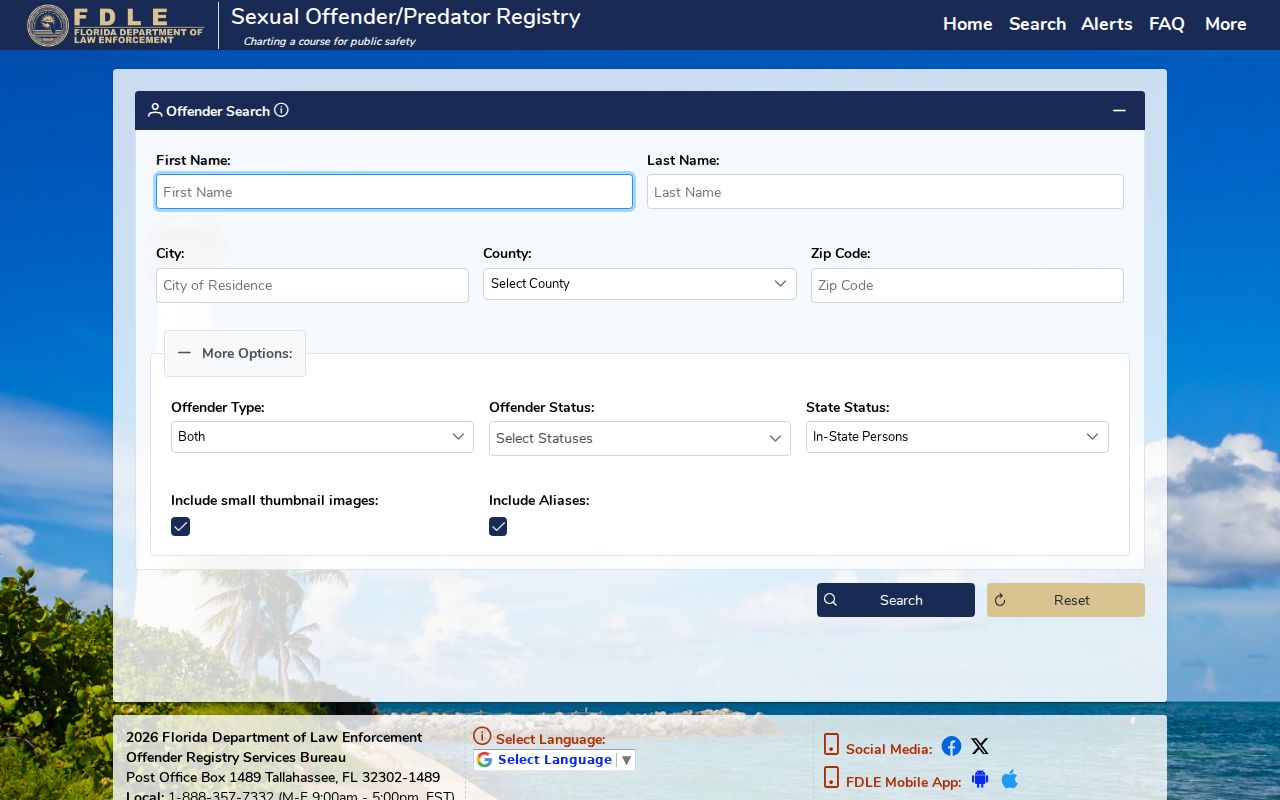
Search status and address data must be checked because registrants move, and the information cannot lawfully be used to harass or threaten anyone.
Lawful use. Use Oakland Park resident records for lawful personal research. Florida law prohibits stalking, harassment, threats, and misuse of personal identifying information.